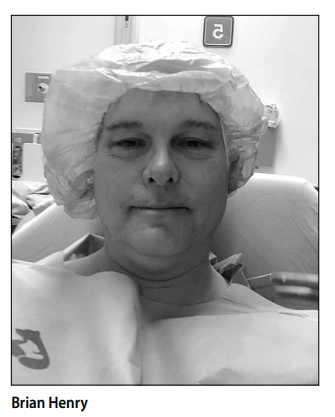
The future is now. Just ask Meadow Lake’s Brian Henry who recently underwent robot-assisted surgery to remove cancer from his liver. “I knew going in it would be a robot-assisted surgery,” Henry told Northern Pride. “According to what my surgeon told me is they uploaded all my information, all the 3D imagery from my CT scan into an artificial intelligence (AI) program. The AI works with the surgeon – essentially the surgeon is in control of all the little robot arms and whatnot – but, at the end of the day, I think it’s really good. I had a right renal cell carcinoma stage 1. It was quite large and was ready to metastasize at any point and move on to stage 2 or possibly stage 3 cancer. We were just lucky and caught it early. Being the surgery was robot-assisted, however, I find the healing time was a lot faster. I was in and out of the hospital, which is good.”
Although Henrys surgery took place at St. Paul’s Hospital in Saskatoon, other Saskatchewan patients are benefiting from a newly added robot-assisted surgical (RAS) system located at the Royal University Hospital (RUH) also in Saskatoon. This is now the fourth robotic system operating in Saskatchewan – one of the highest per capita of any Canadian province. Two other systems are located at St. Paul’s while another was introduced to the Pasqua Hospital in Regina last fall. “With the continued expansion of our robot-assisted surgical program, more patients will have access to minimally invasive surgical procedures that result in quicker recoveries close to home,” provincial health minister Jeremy Cockrill said. “I want to extend a sincere thank you to our surgeons and health care teams for continuing to work together to help expand surgical access in our province.”
Since the fourth robotic system was launched in December 2025, nearly 20 surgeries have been performed at RUH in Saskatoon using the da Vinci Surgical System, including colorectal (partial or full removal of the colon) and hepatobiliary (affecting the liver, gallbladder, bile ducts and pancreas) surgeries. “The surgical robot at Royal University Hospital represents a major advancement in surgical innovation for Saskatchewan, enabling safer, more precise procedures and faster, more effective recovery for certain patients,” Saskatchewan Health Authority provincial head of surgery Dr. Michael Kelly said. “Robotic-assisted surgery strengthens surgical capacity, expands access across the province and reinforces Saskatchewan’s leadership in advanced surgical care. With four robotic systems now in operation, three in Saskatoon and one in Regina, this cutting-edge technology is helping attract and recruit highly skilled surgeons and other team members. This will reinforce the province’s surgical workforce and ability to deliver cutting-edge care.”
In the past 12 months, 438 robot-assisted procedures – one being Henry’s – have been performed in Saskatoon and 58 in Regina, which includes everything from common general surgeries, such as hernia repair, to specialized cancer treatment procedures for both male and female reproductive organs, such as proctectomies (prostate removal) and hysterectomies (uterus removal). “I went in with a smile on my face because I knew I was getting rid of cancer,” Henry continued. “Things went dark nice and quick because that’s what I asked for – I didn’t want any of the lead-up or any of the bullshit – I said, once I’m on the table, put me out and have a nice day. I have six small incisions, and, like I said, I was home in two days. I wasn’t pain-free. I could have been on a whole pile of pain killers, but was able to come home from Saskatoon by just taking Tylenol. I lost about 50 per cent of my kidney.”
Henry’s surgery took place Jan. 30. “I believe this (robot-assisted surgeries) are a good advancement in technology,” Henry noted. “My largest incision is maybe two-and-a-half inches or three at the most. The others are maybe once-centimetre incisions. I just feel lucky we caught the cancer early. I went in for something else and I rarely go to the doctor or the hospital because we’re all stubborn men. As the old story goes, though, it’s the stubborn men who die the soonest. I got lucky, and I also have a sense of survivor’s guilt because there are so many people with cancer who didn’t catch it early and which isn’t as easily treated as mine was. I don’t have to do chemotherapy or radiation or anything. They went in, snipped out the cancer, zipped everything back up and there you go.” Since 2025, Saskatchewan has invested $2 million annually in ongoing funding to continue expanding the provincial surgical robotics program