Subscribe to the E-newspaper via Local Ink here.
Water treatment plant officially opens
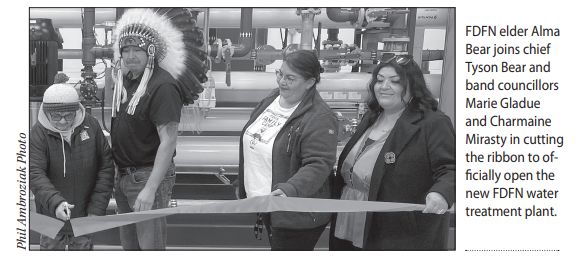
Flying Dust First Nation has taken another huge step toward independence and selfsufficiency. A ribbon-cutting ceremony took place last Thursday (Oct. 29) at the new FDFN water treatment plant located behind the Meadow Lake RCMP station, marking the official opening of the facility which actually first came online in September. “Today marks a momentous occasion for Flying Dust,” remarked Carolyn Lachance of FDFN communications and FDFN economic development.
This was echoed by FDFN chief Tyson Bear who described the water produced at the plant as second to none. “This has been a dream for the last 35 years – to become independent and have our own water source,” Bear said. “A good, healthy, safe water source has always been a goal of the leadership. Fifteen years ago, when I first started working for Flying Dust, the goal was to one day have our own water treatment plant, to gain that independence and be able to have control of one of the necessities of life. Water is one of them.” For years, Flying Dust First Nation was serviced by the same water treatment plant that services the City of Meadow Lake. According to city officials, when recently discussing the possibility of increasing water and sewer rates, it was noted the city shut down the water lines into Flying Dust as of 11:18 a.m. Sept. 21. “I would like to thank the support of Indigenous Services Canada (ISC), of past leadership – I was probably only about 10 years old when I heard the chief at the time talk about wanting our own water treatment plant,” Bear continued. “As I grew into leadership, I had the guidance of (former chief) Richard Gladue to go forward and try to advocate and lobby to get our own water treatment plant. We knew it would be a difficult process because we already had access to water, but to have the option of having healthy and safe drinking water is always important.”
Bear went on to acknowledge others who contributed to the project including project manager Peter Mansuy, operator Less Watt, Meadow Lake Tribal Council tech services, BCL Engineering Ltd. and Trans Canada Contracting Ltd. “Peter Mansuy stuck beside us as project manager – I’m grateful for him,” Bear noted. “I’m also grateful for my friend Les Watt for being the operator, for having the knowledge and for taking the bull by the horns to learn how to take something new and run with it. I trust him. I’d like to thank the Meadow Lake Tribal Council tech services for helping us coordinate and bring things along, BCL for all the hard work and hours they put into the engineering, and I am grateful to Trans Canada for bringing the manpower here and having the expertise to bring everything to life.”
Watt also took a few minutes to explain to those in attendance for last week’s gathering how the water treatment plant works. “We’re pulling ground water – the wells are deep underground,” Watt said. “The well water comes in, it gets fed through these big tanks where there is iron-eating bacteria, manganese and ammonia removal primarily in here. From here, it goes to the filtered water chamber, there is separate set of pumps that takes it to the membrane treatment unit where it is further purified. It then is pumped to the calcite tanks where it’s re-mineralized a little bit. We also add a little bit of chlorine – not as much as Meadow Lake uses – but we need to have some there. It then goes into a giant reservoir beneath where we’re standing right now. From there it’s pumped out to the community. Everything has been working really good so far.”
The new water treatment plant is about 500 square metres in size and includes two new water wells and a 150-millimetre raw water main. The plant cost about $15,206,200 to develop, $10,200,000 of which was contributed by ISC. Meanwhile, Bear also reiterated, with the opening of the water treatment plant, FDFN is that much closer to total independence and self-sufficiency. “Water is one of the keys in life, and now we’re in control of it,” he said. “The water tastes better than the stuff out of the bottle. It was the elders’ guidance from the very beginning who made this happen… For 35 years we have been on another water supply and the water quality has diminished the last few years because of the population and because of the supply in general. We now have good, healthy, clean and safe drinking water… Now we can move on to new challenges.”