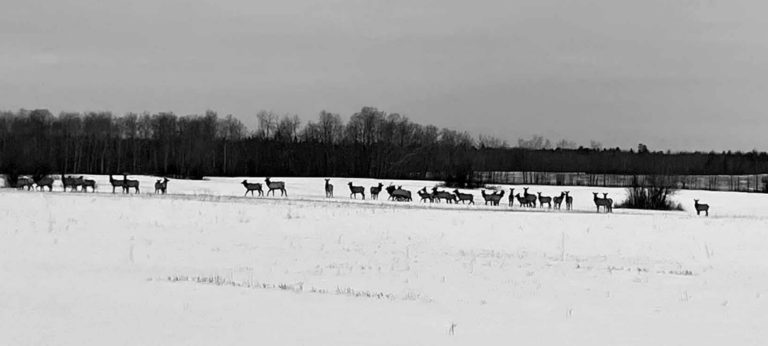
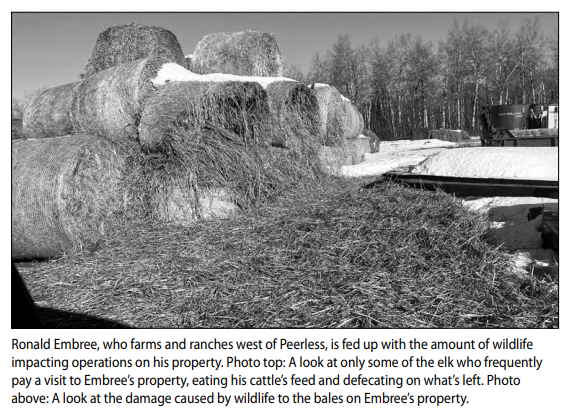
Rancher Ronald Embree’s herd, it appears, has its own personal taste-testers. But, as regal as this may sound, it’s actually more of a royal pain the you know what. Embree, who ranches west of Peerless, said his entire operation has been suffering as of late because of the increased amount of wildlife that makes its way onto his land, eating and defecating on the feed belonging to his close to 120 head of cattle.
“The wild deer and elk are getting out-of-hand,” Embree told Northern Pride. “Once hunting season is done in the fall and no one is chasing them anymore, they hit my stacks. As a farmer, you try to keep expenses down. I like to feed my cattle out in the field and not bring them back to the yard until calving. But, I can’t even put feed out there. The deer are eating it, and, what they don’t eat, they’re defecating on. I can’t even farm properly anymore because of the wild animals.” Embree said this is an issue about 15 years in the making, but one that’s gradually been growing worse with each year that goes by. “It’s pretty bad when your cows go out and sniff the feed before they eat it,” he added. “The wildlife are destroying the way I farm. There’s overpopulation going on, and, while the government apparently has all kinds of studies it’s done, it doesn’t address the actual problem. They don’t do anything.” Embree said he’s reached out to a number of organizations and individuals for help and guidance, with Saskatchewan Crop Insurance providing some compensation for feed. “But, it’s on their terms and they’re a problem to fight with,” he said. “That’s the only compensation you can get and it’s not covered to the full, actual value. There’s also so much more in the way of losses than just feed. The wildlife is wrecking fences, they’re wrecking the way I farm. I have to bring the cattle out of the fields, which is costing me more because now I have to feed them in the corrals.”
Embree said he has also reached out to the Canadian Cattle Association, the Ministry of Environment, as well as Meadow Lake MLA Jeremy Harrison about his concerns, but said he can’t get a clear answer as to what he, or anyone for that matter, can do to address the issue. “Saskatchewan Environment is more interested in being cops now, and they have no chequebook so they point the finger back to Saskatchewan Crop Insurance,” Embree continued. “When you go to Saskatchewan Agriculture, they just sit there and twiddle their thumbs before pointing things back to Saskatchewan Crop Insurance. But, again, this is beyond feed. It’s starting to impact everything I do as a farmer, and I can’t find anybody with a chequebook. Wildlife has just been tormenting the heck out of me.” Embree said he’s seen upward of 70 elk on his property at one time, as well as a total of 30-40 deer on a daily basis. Meanwhile, other avenues Embree has pursued have included bringing in Indigenous hunters to hunt the animals outside of the traditional hunting season, as well as utilizing blast cannons and strobe lights in an attempt to frighten the wildlife off. Nothing has been effective. “This isn’t my problem,” Embree said. “I didn’t invite the wildlife. Who is responsible for them? Somebody should be responsible. Why do I have to suck things up and incur the expenses? It really makes you sick and tired of getting out of bed in the morning.”
For the past four years, Embree said he’s also had the added expense of vaccinating his cattle for liver flukes, something else he has never been compensated for. “As a producer, what do you do?” he asked. “I’ve been screaming. I’ve been tearing my hair out. I need answers. I’d like to invite these guys (government officials) over for dinner some time. But, they will get served off my plate after I’ve taken some bites out of it. Let’s see how they like it. That’s how my cows have been treated. They’ve been eating secondhand feed.”
Northern Pride reached out to MLA Jeremy Harrison for comment on the concerns shared by Embree, but he was unavailable as of this week’s news deadline. In the meantime, Saskatchewan agriculture minister David Marit recently announced changes to the 2026 AgriStability Program, administered by the Saskatchewan Crop Insurance Corporation (SCIC). This follows through on the province’s ongoing commitment to ensure its business risk management programs remain relevant and further support Saskatchewan livestock producers. “These AgriStability Program enhancements better recognize feed costs and pasture use, providing more meaningful and responsive support for our livestock producers,” Marit said. “Our government has been responsive to the sector’s requests, ensuring producers have access to relevant programs they need to manage risk and remain resilient.”
Starting in the 2026 program year, for operations that rent pastureland for grazing, the costs associated with the rent or lease will be considered as allowable expenses for AgriStability. The expense must be reflective of a reasonable feed volume for the animals grazed. The producer needs to demonstrate the transaction is for access to livestock feed, not for crop or forage production. As previously announced, also starting in the 2026 program year, AgriStability is adjusting the feed inventory pricing for livestock producers. This accounts for feed destined to be used on the farm and not sold. When feed prices rise, the value of ending inventories can increase, potentially offsetting losses of actual feed production. This modified calculation will use the end of year price along with opening and ending feed quantities to calculate the value of the inventory change.
“Strong risk management programs are essential for Saskatchewan cattle producers to remain competitive and resilient,” Saskatchewan Cattle Association (SCA) chair Chad Ross said. “SCA has worked hard to ensure producers have responsive and practical programs available to them. We appreciate the announced enhancements to the 2026 AgriStability Program. These improvements will help Saskatchewan producers more effectively manage their risks.”