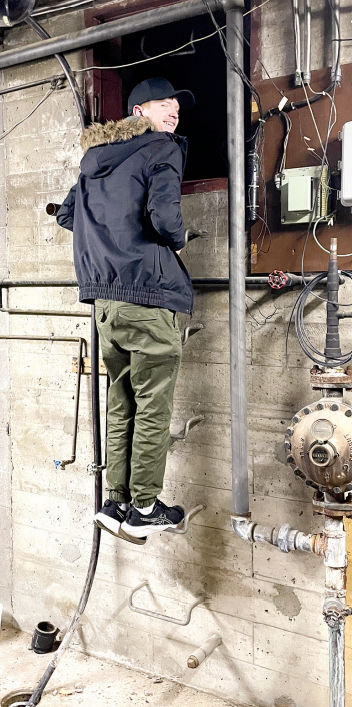
Armed with a borrowed key, a bit of Cold War curiosity and more questions than answers, history students from Meadow Lake’s Carpenter High School recently went searching for the long-talked about bomb shelter beneath the Meadow Lake Civic Centre. Their search led them to uncover a concrete mystery that suggests the nuclear age may have hit closer to home than most people realize. “We’re looking at the Cold War in History 20 and talked about the bomb shelter era and how most communities had a bomb shelter,” explained CHS teacher Derek Eftoda. “Through some calling around and according to urban lore, I heard the old bomb shelter in Meadow Lake was located in the basement of the Civic Centre.” Eftoda then made a call to the City of Meadow Lake to make an official inquiry. “They didn’t have any information, but offered a key to the Civic Centre so my class and I could go and investigate,” Eftoda added.
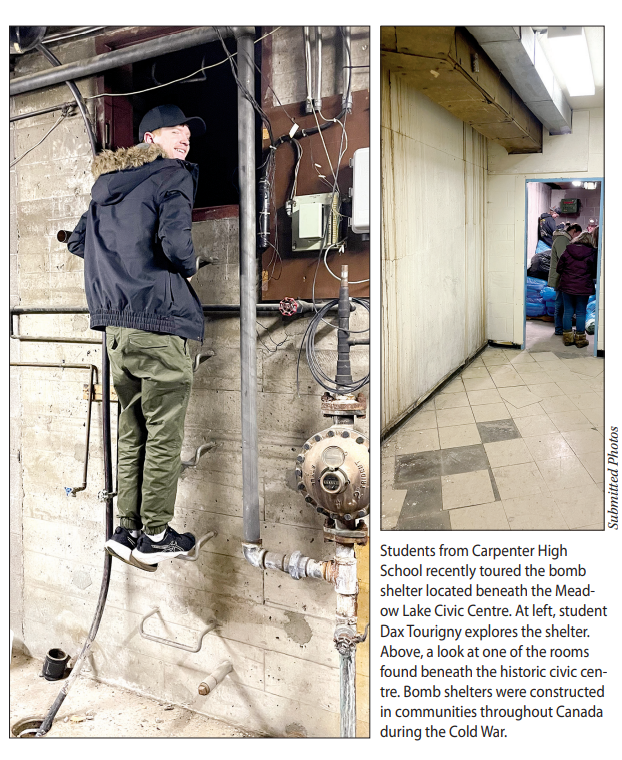
This past Monday (Dec. 15), Eftoda, joined by fellow teachers Dion Petz and Brian Brander, took Eftoda’s Grade 11 history class and collected the key. “My class went and explored,” Eftoda continued. “It was hard to determine what was part of the original build and what had been added or altered in later years. We ended up finding a small concrete enclosure in the centre of the structure. It looks as though the original door has been closed in all but a small opening access door.”
Later that night, Petz and Eftoda did some more digging by contacting a few people who might have an idea about the original construction and any info about it. “What we learned was the bomb shelters were never intended as a public shelter,” he noted. “They were intended to be for only a few people, usually a high ranking government official, to allow them to survive the blast/fallout, and take radiation level readings and relay those reading to the outside. Being situated so close to the Cold Lake airbase, which would have been on a target list for a Soviet bomb, Meadow Lake would have experienced significant fallout being downwind of Cold Lake.” In 1958, Prime Minister John Diefenbaker announced plans to build fallout shelters across Canada. Fallout, of course, being the harmful radioactive matter left in the environment after a nuclear bomb goes off. These shelters would ensure the Canadian government continued to operate during and after a war.
In closing, Eftoda expressed how exciting it was to share the experience of exploring the bomb shelter with his students, adding it’s an important piece of the community’s history. “It was a cool experience for all of us, but we have more questions than answers now,” he said. “I would really appreciate any information from anyone who has any insight/ knowledge about the original construction and intention of this place.”