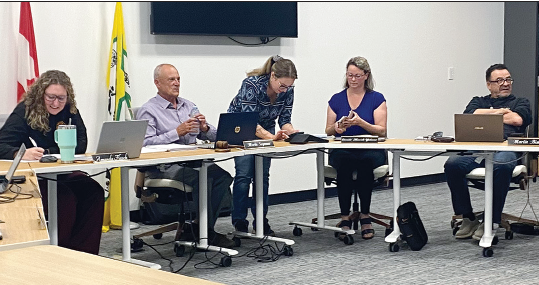
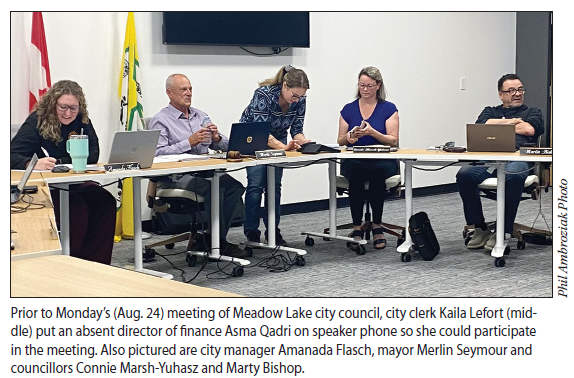
All roads lead to Flying Dust First Nation. During Monday’s (Aug. 24) meeting of Meadow Lake city council, first reading was given to a bylaw that will ultimately see Neheyo Road between Giant Tiger and the Meadow Lake RCMP detachment closed… well, not really. “The city has received a request from Flying Dust First Nation to close the road known as Neheyo Road between Giant Tiger and the RCMP detachment as a step in their recovery of this land,” explained city clerk Kaila Lefort in her official recommendation to council. “Per the letter received from Flying Dust in 2023, there is no intention of physically closing this road as the First Nation considers it be to an important access point between their community and the City of Meadow Lake. The closing of the road is a technical requirement on paper only to enable the land transfer to take place. The ownership of the road lies with the province; however, the administration and control is with the city.”
Lefort went on to note previous city administration encountered a small legislative issue at the time this item was initially considered. “Flying Dust was advised by the ministry it needed the city to close the lane, as title of a lane parcel cannot be transferred or sold without a road closure bylaw that closes the road first,” she noted. “However, we may not close a road that is intended to still be used as a road, resulting in a legislative loop. At that time, council tabled the item.”
In January 2026, FDFN submitted a request regarding Neheyo Road, and Land Management Services reached out to the city as it remained an outstanding parcel from the Treaty Land Entitlement process. “Since that time, administration attended a meeting with FDFN and a senior land claim advisor from the province outlining next steps,” Lefort’s recommendation continues. “It was confirmed the city must adopt a bylaw to provide for the close and transfer of Neheyo Road, which is the aim of this request.” The motion to give the bylaw first reading Was made by councillor Conrad Read and seconded by councillor Mauri Young. “Basically, this is just a housekeeping thing,” stated mayor Merlin Seymour during Monday’s meeting. “The road isn’t going to be closed. We’re just turning over ownership of it to Flying Dust… We are only giving this first reading tonight, as it has to go out for advertising (before all three readings and final adoption can be given).
Treaty Land Entitlement (TLE) is aimed at resolving outstanding obligations to First Nations which did not receive all of the reserve land they are entitled to under treaty. The federal government and First Nations signed numbered treaties between 1871 and 1906 in the region that is now Saskatchewan. A key aspect of those treaties was the allocation of reserve land to First Nations people. Canada agreed to establish reserves based on the First Nation’s population at the time of the original survey. However, this did not happen in all cases leaving the federal government with outstanding obligations. First Nations and the land reserved for them are a federal responsibility. However, under the Natural Resources Transfer Agreement, 1930, Saskatchewan is legally obligated to help Canada fulfill TLEs. Under this agreement, Canada transferred the remaining Crown land, minerals and resources to Saskatchewan. In return Saskatchewan agreed, among other conditions, to make unoccupied Crown land available to fulfill outstanding TLE obligations. By the 1970s the amount of available unoccupied Crown land was not sufficient and/or in suitable locations to settle all outstanding TLE claims. As a result, attempts to address these claims at that time were unsuccessful. Another solution was eventually developed in the early 1990s. In 1992, the Governments of Canada and Saskatchewan and the chiefs of 25 entitlement First Nations signed the Saskatchewan Treaty Land Entitlement Framework Agreement.
The significance of this agreement is it established a framework to address outstanding treaty obligations and ensure First Nations obtain the amount of reserve land to which they are entitled. Under the TLE agreements, First Nations received monetary compensation to purchase land on a “willing seller/willing buyer” basis. The framework agreement is comprehensive. It serves as a blueprint for all the subsequent TLE agreements in Saskatchewan and is regarded as a model of success for the resolution and implementation of TLE. Meanwhile, the city did issue a letter to nearby residents informing them their properties could be impacted by the potential road closure. However, the city did not receive any written feedback as of Monday’s meeting.