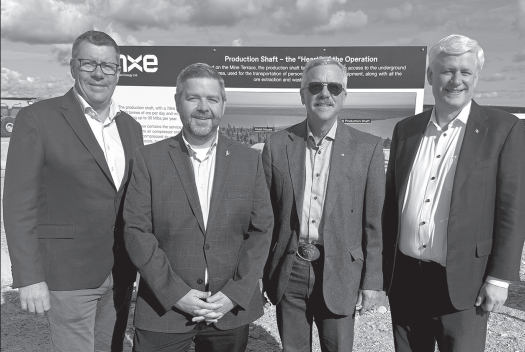
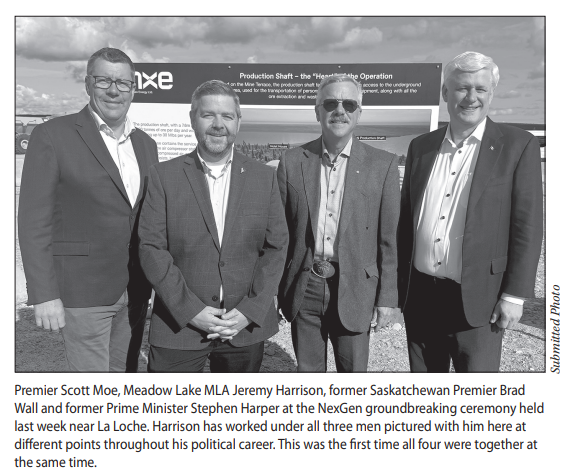
A new uranium mine in northwest Saskatchewan is officially getting off the ground – marking a significant step toward putting the province’s nuclear ambitions into action. Last Thursday (Aug. 13), an official groundbreaking ceremony took place at NexGen Energy Ltd.’s Rook I site north of La Loche. “Today, we transition from demonstrating what this project will be to delivering it — for the benefit of local communities, Saskatchewan, Canada and the world,” remarked NexGen founder and CEO Leigh Curyer. Several dignitaries were in attendance for last week’s groundbreaking ceremony including Desnethé-Missinippi-Churchill River MP and secretary of state for rural development Buckley Belanger, Premier Scott Moe, former Premier Brad Wall, former Prime Minister Stephen Harper and Meadow Lake MLA Jeremy Harrison.
“This was a great announcement for a project that is going to have enormous significance in the global nuclear supply chain,” Harrison told Northern Pride. “It will be the largest uranium mine in the world and I’m proud to have been working with NexGen for over a decade to get to the point we are at today with significant construction activities occurring at the mine site.” Harrison went on to say NexGen did a great job with the announcement event itself by inviting the prominent political leaders who also all worked hard to get the project through the approval processes. “It was a pretty remarkable day for me personally to share time with the three individuals who I’ve spent my 25 year career in public life working for and with (Moe, Wall and Harper),” Harrison added. “I’m told I am the only person to have ever served in the same caucus of all of them which is special considering they are probably the three most significant centre right leaders of the last 30 years of Canadian history.”
Meanwhile, according to NexGen, the $2.2-billion uranium mine project will be constructed over the next four years. Once it is up and running, the company says it could produce approximately 30 million pounds of uranium annually. The project also comes at what is considered a boom time for demand for uranium and clean energy all around the world. “The world is changing,” Curyer noted. “Artificial intelligence, advanced manufacturing, electrification and energy security are driving unprecedented demand for electricity. Nuclear energy has become key to meeting that demand — and with it, uranium has become one of the world’s most strategic resources. This project is also about creating careers, supporting Indigenous businesses, building local capacity and investing in infrastructure. It is about creating opportunities for young people to build their futures at home here in northern Saskatchewan.” Harrison said Rook I is a major new uranium mining project in the Athabasca Basin, centred on the high-grade Arrow uranium deposit, and is expected to become one of the largest uranium mines in the world once it reaches production. “This represents a $2.2-billion privatesector investment in Saskatchewan and will create significant opportunities for workers, businesses and communities in the north,” he said. “Projects of this scale have a real impact on Saskatchewan families, creating good jobs and generating economic opportunities that will extend well beyond the mine site.”
Harrison also said Saskatchewan is home to some of the best uranium resources anywhere in the world, and the global demand for reliable, affordable and low-emissions electricity is growing. “As countries turn increasingly to nuclear power, Saskatchewan has an enormous opportunity to supply the uranium that will help power that growth,” he said. “We’re proud to see Rook I moving from an ambitious proposal to construction. It is a great example of Saskatchewan’s resource advantage, our skilled workforce and the benefits that come from working with industry, northern communities and Indigenous partners to get major projects built.” According to a NexGen news release, 300 people are currently working at the site. To date, more than 575,000 tons of aggregate have been crushed and stockpiled by a Clearwater River Dene Nation-partnered business, supporting up to 50 local jobs. The company also said in its news release that major earthworks and surface infrastructure are advancing at the site, expanded site accommodations are now complete and occupied, and an initial 3,000-foot airstrip has been commissioned. It is expected that the full 5,840-foot airstrip will be completed by December 2026, with shaft development planned for 2027.