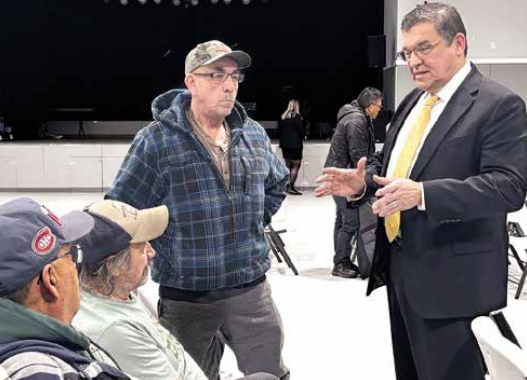
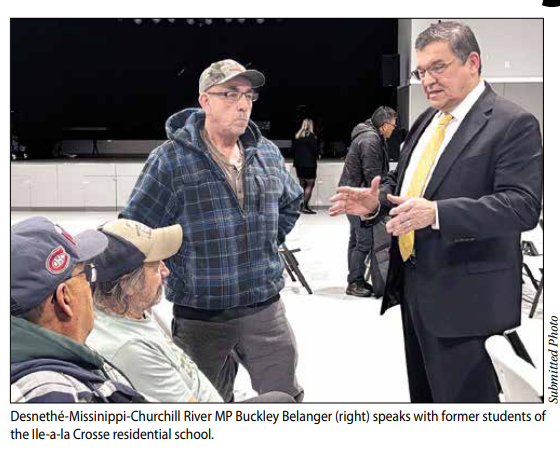
It was a history-making day in the Northern Village of Ile-a-la Crosse recently. Last Thursday (Jan. 29), Desnethé-Missinippi-Churchill River MP Buckley Belanger, who also serves as the Liberal government’s secretary of state for rural development, joined plaintiffs Louis Gardiner, Margaret Aubichon, Melvina Aubichon, Emile Janvier, Duane Favel and Donna Janvier to announce an agreement in the class action suit regarding the former Ile-a-la Crosse residential school.
“Today is about the survivors of Ile-a-la Crosse School,” Belanger remarked. “They waited a long time for this moment, and they worked hard to get here. I am incredibly honoured to stand with them as we take this important step toward justice and fairness with this proposed settlement with the Government of Canada.” The Ile-a-la Crosse school operated from the 1860s until the 1970s, and the students who attended were mostly from Métis communities and First Nations in northern Saskatchewan. Since an agreement-in-principle was reached in 2025, the Government of Canada and the lawyers for former students of the Ile-a-la Crosse school have been working to find a fair, compassionate and respectful way to resolve the litigation. These talks led to the settlement agreement signed last week. “Today’s settlement recognizes the profound harm suffered by former students of Ile-a-la Crosse school and the courage it took for them to come forward,” noted Rebecca Alty, federal minister of Crown-Indigenous relations. “While no settlement can undo their pain, it is an important step toward recognizing their experiences. Reaching this outcome outside of the courts reflects an approach that prioritizes dignity and respect and I commend the diligent work done by all parties to achieve this outcome.”
With this agreement, Canada will give individual compensation, to be provided directly to former students for the experiences they endured while at the Ile-a-la Crosse school. Compensation of up to $10,000 for less than five years attendance and up to $15,000 for five or more years attendance is possible. Under the agreement, an independent, court-appointed third party administrator will decide the compensation for attendance at the Ile-a-la Crosse school. Canada has also agreed to provide $10 million to support healing, wellness, protection of languages, education and commemoration for former students of the school and their families. A non-profit organization will be set up to receive and review funding applications. It will also set the criteria used to decide which applications are eligible. Canada will pay to administer the settlement and legal costs. This settlement is separate from the settlement that was reached between former students of the Ile-a-la Crosse school and the Province of Saskatchewan.
“This is a big step forward for our survivors in terms of finding closure, which comes only after a long and hard fight for recognition of what we endured at the Ile-a-la Crosse residential school,” Gardiner said. “If court approval is granted, I believe this settlement will help us toward a healthier future.” Margaret Aubichon agreed. “We have spent many years calling on the federal government to address the harms we endured at the Ile-a-la Crosse residential school, so it is meaningful we have finally reached this settlement agreement,” she said. “Although there is more healing work to be done, this settlement will provide important recognition and compensation for survivors, our families and our people.”
Next steps in the process are as follows: Canada will ask the court to approve the agreement March 30-31. The court will look at whether the settlement is fair, reasonable and in the best interests of the former students of the Ile-a-la Crosse school and their family members; former students of Ile-a-la Crosse school and their family members will be also able to review the proposed settlement agreement and share their comments with the court; if the court approves the settlement, former students will be able to submit their claims to the independent third party administrator; after the agreement receives court approval, more details about the implementation, including how, where and when to apply, will become available; at the hearing, the court will also consider the separate settlement reached between former students of the Ile-a-la Crosse school and the Province of Saskatchewan.
“The residential institution at Ile-a-la Crosse caused much mental, physical, emotional, spiritual, and cultural harm to all survivors – both deceased and living, stated Melvina Aubichon. “I hope the federal government’s acknowledgement of the harms caused by the Ile-a-la Crosse residential school helps to address the suffering of all those involved.”